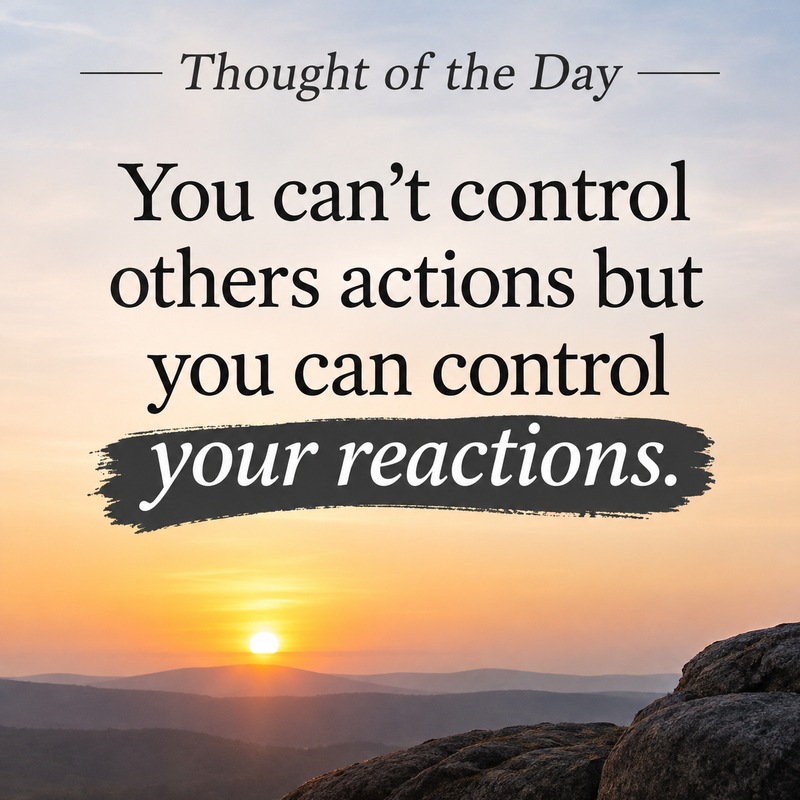
You Can’t Control Their Actions, But You Can Control Your Reactions
Scripture: Proverbs 16:32 (NKJV)
“He who is slow to anger is better than the mighty, And he who rules his spirit than he who takes a city.”
One of the hardest lessons we learn in life is that we cannot control what other people do. We cannot control what they say, how they treat us, the decisions they make, or even what they think about us.
But we can control how we choose to respond.
Think about how much time we spend allowing someone else’s actions to dictate our emotions. Someone says something hurtful, and suddenly our entire day is ruined. Someone disrespects us, and we feel the need to defend ourselves. Someone disappoints us, and we allow bitterness or resentment to take root in our hearts.
But here’s the question: Why are we giving someone else that much control over our peace?
Jesus never promised that people would treat us fairly. In fact, He experienced betrayal, rejection, false accusations, and unimaginable cruelty. Yet even while hanging on the cross, He prayed for those who were crucifying Him.
That’s a powerful example of what it means to respond according to God’s character rather than someone else’s behavior.
James 1:19 (NKJV) reminds us:
“So then, my beloved brethren, let every man be swift to hear, slow to speak, slow to wrath.”
Notice that Scripture doesn’t tell us we will never become angry, frustrated, or hurt. Those are human emotions. But it does teach us to be intentional about what we do with them.
There is a difference between having an emotion and allowing that emotion to control your actions.
Sometimes the most powerful response is silence. Sometimes it’s walking away. Sometimes it’s extending grace when someone doesn’t deserve it. And sometimes it’s having a difficult conversation with love instead of anger.
And let’s not confuse controlling our reactions with allowing people to mistreat us. You can establish boundaries, confront wrongdoing, and stand firm in truth without responding in anger or seeking revenge.
Here’s something else to consider.
When we allow someone else’s behavior to determine how we behave, we are allowing them to influence the very character God is developing within us.
We cannot expect everyone around us to demonstrate the fruits of the Spirit. But as followers of Christ, we are called to demonstrate them ourselves.
Galatians 5:22–23 reminds us that the fruit of the Spirit includes love, peace, patience, kindness, gentleness, and self-control.
Those qualities aren’t tested when everyone is treating us well. They’re tested when people aren’t.
So today, before you react to something someone says or does, ask yourself:
Am I responding out of my emotions, or am I responding in a way that honors Christ?
Am I trying to prove that I’m right, or am I trying to reflect His character?
And perhaps most importantly, am I allowing someone else’s actions to steal the peace God has given me?
Remember, you may not have a choice in how someone treats you, but you do have a choice in how you respond.
Don’t allow someone else’s lack of self-control to become your lack of self-control.
You cannot control their heart, their words, or their actions. But through the power of the Holy Spirit, you can learn to govern your own.
Your reaction is your responsibility. Make sure it reflects the One you follow, not the one who offended you.
— Rev. Carlos Figueroa TheFreeBible.org